
What is happening
Engineering firms take engines from decommissioned aircraft and convert them into stationary generators, and data-center operators are buying them as fast as they can be made. The pressure comes from two directions: grid connections that take years, and federal pressure on developers to generate their own power.
- Several converters. ProEnergy, in Missouri, converts a General Electric engine flown on Boeing aircraft. FTAI Aviation converts retired Boeing 737 and Airbus A320 engines, and a joint venture signed the $1.5 billion supply deal in July.
- The driver is speed. One AI infrastructure chief executive told the Times that developers now focus on “speed to power”.
What the report questions
- Emissions. According to the Times, xAI's permits in Mississippi allow carbon monoxide at twice the rate of the other turbines on the site and a 25 % higher limit for volatile organic compounds. The Southern Environmental Law Center has challenged the approval.
- Efficiency. Converted aircraft engines are generally less fuel-efficient than turbines built for modern power plants, so a site needs more of them for the same output.
- Upkeep. Critics quoted in the report point to maintenance costs, fuel needs and heat.
What this shows
The demand is real: developers will choose on-site power over a long wait for the grid. But an aircraft engine bolted to a generator is not yet a power plant. The units that last will be the ones designed for continuous ground duty from the start, with emissions control, efficient power conversion and a clear maintenance plan.
Where CROSSOVER fits
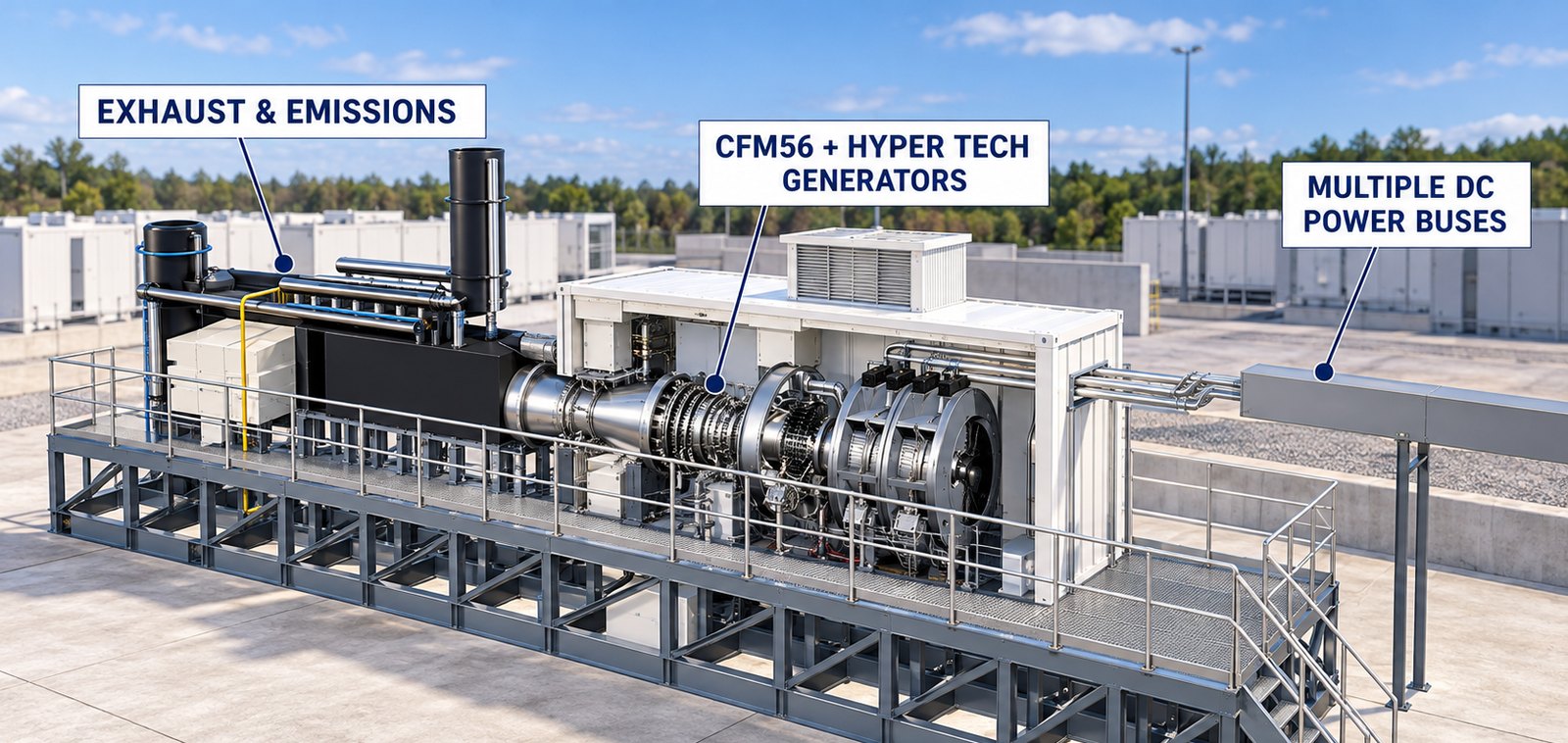
- Designed as a power plant, not a retrofit. Each unit is built on factory skids around an existing aero-engine core, with an exhaust and emissions module, a fuel-gas skid and a filter house designed in from the start.
- 800 V DC at the generator. Hyper Tech generators make 800 V DC directly, on isolated buses, with no medium- and low-voltage transformers, switchgear or separate rectifiers between the turbine and the racks: fewer conversion steps and fewer pieces of equipment.
- Behind the meter. CROSSOVER runs on pipeline natural gas, so a site does not have to wait for a large grid connection.
- Fast to install. Each unit is set up from three 40 ft modules, with a 72-hour install as the engineering target.
- On the 800 V DC timetable. CROSSOVER targets its first unit and pilot in Q2 2028 and volume production in 2029.
On-site generation does not avoid permitting: emissions, noise and fuel supply are assessed like any other plant. CROSSOVER is designed to meet that review rather than work around it.
Read with care: Hyper Tech is not affiliated with xAI, ProEnergy, FTAI Aviation, General Electric, Boeing, Airbus or any company in the report, and takes no position on their permits, which are for the regulators and the courts. Facts about other companies are as reported by the sources below. CROSSOVER is a development program; ratings, emissions, install times and dates are design targets.
Need power on site without waiting for the grid?
Data-center developers and investors can see the technical package, site economics and financial model under a mutual NDA.
Request the NDASources
- The New York Times (republished by GV Wire): “Old, Polluting Jet Engines Are Being Scavenged to Power Data Centers”, Hiroko Tabuchi and Gabriela Bhaskar, November 3, 2026.
- Business Standard: report on US AI data centers turning to retired jet engines for power, November 4, 2026.
- Hyper Tech: CROSSOVER, power for AI data centers and CROSSOVER: 72 hours to power.
Earlier posts: 800 V DC at the generator · The UK’s largest planned AI supercomputer waits for grid power · Vantage reserves 1 GW of 800 V DC converters · NVIDIA’s DSX POD and 800 V DC power on site