
What NASA found
AACES 2050 (Advanced Aircraft Concepts for Environmental Sustainability) is a NASA Advanced Air Vehicles Program effort with Boeing’s Aurora Flight Sciences, Electra, Georgia Tech, JetZero and Pratt & Whitney, looking at airliners for 2050. After about 18 months of studies, NASA said in June 2026 that it will focus further work on LNG as an aviation fuel.
NASA’s studies indicate LNG “can reduce emissions by 70% or more” and could help “cut operating costs in half”.
Nateri Madavan, director of NASA’s Advanced Air Vehicles Program, AIAA Aviation Forum, June 11, 2026, as reported by Aerospace America
Presenting the findings at the ATI Conference 2026 in the UK, NASA set out why LNG comes first:
- Fuel choice drives the opportunity. It was the strongest single factor across the concepts studied.
- LNG is the transition enabler. Low cost now and long term, pathways to renewable production, lower tailpipe emissions than kerosene, and worldwide shipping.
- Hydrogen needs infrastructure first. It offers zero in-flight CO₂, but NASA put the cost to equip a hub airport with liquid hydrogen at up to 10 times that of LNG.
- Multi-megawatt electrification has to earn its place. NASA’s words: it needs propulsion-airframe integration benefits to “buy its way on”.
Why data centers belong in this story
Aviation’s fuel transition needs the same two things that AI data centers are now paying for on the ground: large electric machines that run reliably, and fuel infrastructure that does not wait for the grid. Building them for data centers first gives aviation hours, supply chains and costs it cannot reach in a flight program alone.
On the ground: data centersIn the air: aviation
Now to 2030 · Pipeline natural gas
Multi-MW DC machines run 24/7 at data centers
→ Machine and power-electronics hours at scale, on the ground
2030s · LNG
Cryogenic fuel storage, transfer and boil-off handling at site scale
→ NASA’s transition fuel: LNG reaching airports
2040s and on · Liquid hydrogen
The same cryogenic chain at about 20 K; superconducting machines and fuel cells on the same DC buses
→ Zero in-flight CO₂, on a supply chain already built
| What aviation needs | What a data center builds first |
|---|---|
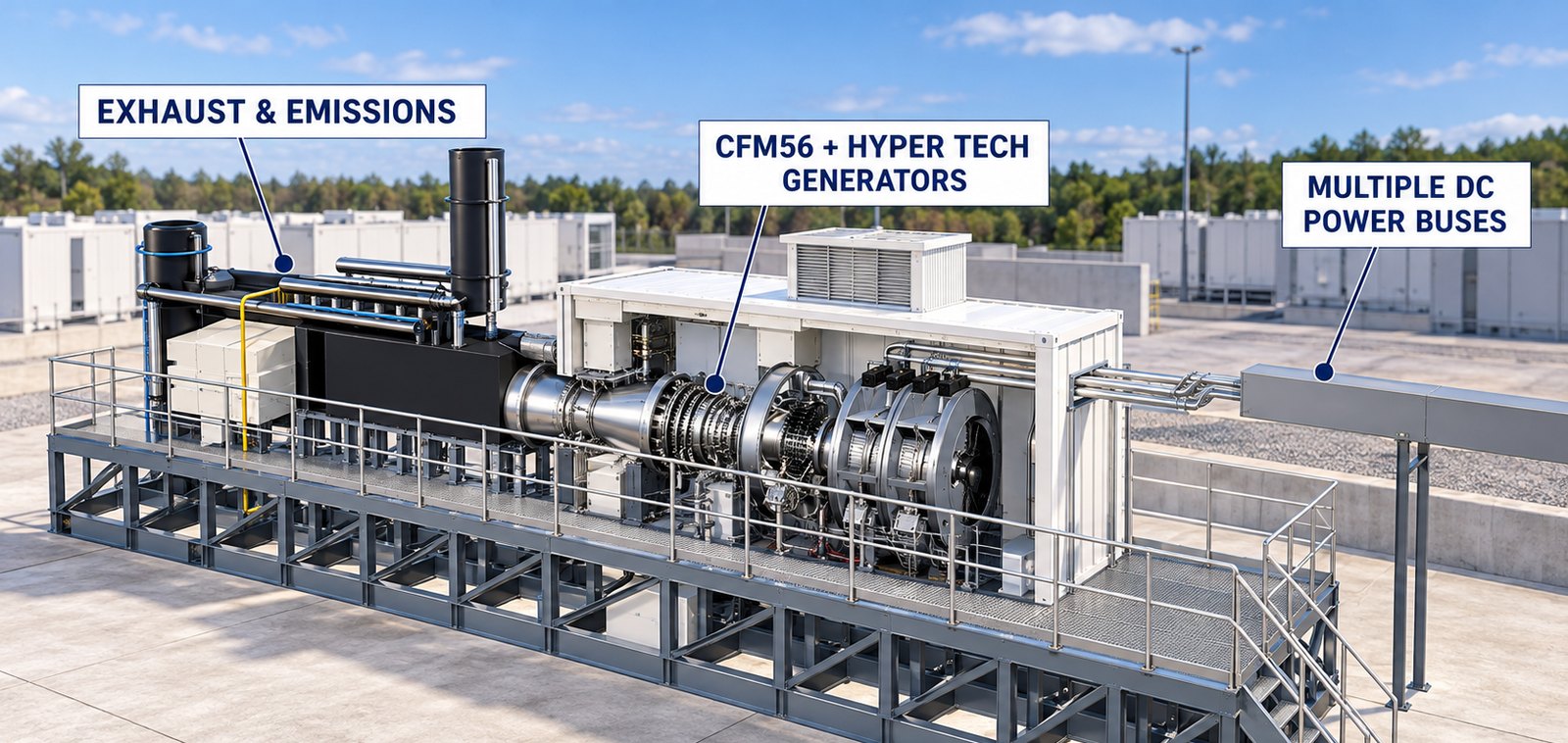
| Multi-megawatt electric machines that “buy their way on” | CROSSOVER runs a 20–24 MW-class DC generator around the clock, at 800 V DC on six isolated buses: years of operating hours and data on the machine and its power electronics, on the ground. |
| LNG at airports, as NASA’s transition fuel | On-site power plants that use natural gas today build the fuel handling, storage and skills that LNG needs; LNG delivered by road or rail is an option where there is no pipeline. |
| Cryogenic machines and thermal management | Hyper Tech’s cryo-cooled motor concepts of 1–3 MW for single- and double-aisle aircraft use liquefied bio-natural gas for cooling, the same fuel NASA is studying. |
| Liquid hydrogen and superconducting propulsion | Hyper Tech develops MgB₂ superconducting wire, 2–10 MW superconducting motor concepts for aircraft, and magnetic refrigeration that liquefies hydrogen at about 20 K. The same 800 V DC buses can later take fuel cells. |
Where CROSSOVER fits
- A proving ground that pays its way. Each CROSSOVER unit is a commercial power plant for an AI data center, so the machine hours come from selling power, not from a test budget.
- Built from aviation. CROSSOVER is built from existing CFM56 aero-engine cores, with Hyper Tech generators making 800 V DC directly.
- On a near-term timetable. CROSSOVER targets its first unit and data-center pilot in Q2 2028, well inside NASA’s 2030s window for LNG.
Read with care: Hyper Tech is not affiliated with NASA, and NASA has not reviewed or endorsed this article or CROSSOVER. Statements about NASA’s findings are as published or presented by NASA and reported by Aerospace America, linked below. CROSSOVER and the aircraft machines named here are in development; ratings and dates are design targets.
Working on aviation’s fuel transition, or on data-center power?
Aerospace partners, data-center developers and investors can see the technical package under a mutual NDA.
Request the NDASources
- NASA: Advanced Aircraft Concepts for Environmental Sustainability (AACES) 2050.
- Aerospace America (AIAA): “AACES 2050 Research Prompts NASA to Pursue LNG for Aviation”, June 2026.
- NASA Aeronautics, AACES 2050 findings, presentation at the Aerospace Technology Institute ATI Conference 2026, UK, November 2026.
- Hyper Tech: CROSSOVER · High Power Density Motors · MgB₂ superconductor wires · Hydrogen liquefaction.
Earlier posts: Data centers now need hundreds of megawatts on site · Retired jet engines are powering AI data centers · 800 V DC at the generator